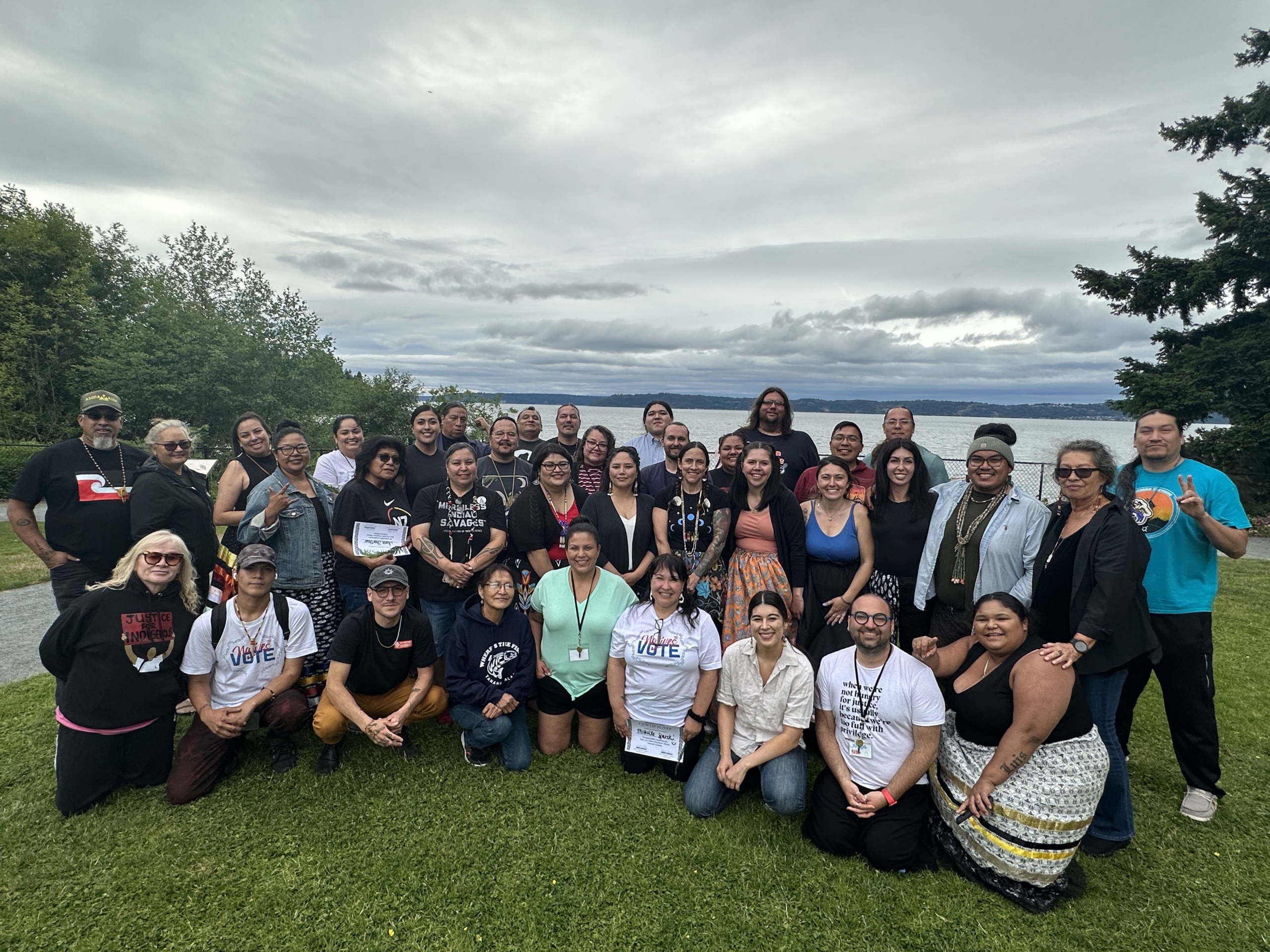


For the Native Organizers Alliance National Native Community Organizer Training in May, 19 participants were brought together in Federal Way, WA for a week of sharpening grassroots organizing skills using traditional Indigenous values. The curriculum is designed to create a foundation for Native power building for social change and strengthening sovereignty.
We’ve asked April Fournier (Navajo), Program Manager at Advance Native Political Leadership, to share her reflections and learnings from the week with us.
NOA: What was your level of understanding of organizing prior to the training? How familiar were you with grassroots organizing prior?
AF: Going into the training I would say that I was fairly informed, but didn’t have a lot of depth in my knowledge of organizing theory and strategy. I had been involved with different movements, but not enough to have deep knowledge. I would say a little more than a surface understanding.
NOA: What were your key takeaways from the training that you feel can be applied to your work?
AF: SO MUCH! Being able to put into words the way in which we operate from an Indigenous Model of Teaching and Organizing. We operate knowing all things work in relation. We have to recognize where power and influence exist in order to understand where power can be shifted. We also have to be strategic and engaging with our communities and come at this work in a good way. When we come into this work with our ancestors on our shoulders, our community in our heart, and the generations who come after us in our minds we change the game.
NOA: What tools or resources do you feel were most beneficial to you and your work?
AF: The Power Mapping activity was so powerful, being able to understand who we should spend our time on when we’re engaging with decision-makers was a really important exercise. It shapes the whole campaign and how we think about energy investment. If someone is a low-impact non-decision maker, why spend time and energy engaging them. We have finite resources, invest them accordingly. Bringing it all together in a group to develop a strategy was also really great, we have to do that regularly so flexing those muscles and putting the learning into action really helped cement what we spent the week learning.
NOA: What was your overall experience of the training? Any particular aspect you enjoyed the most?
AF: I’ve not ever had the chance to sit in community with so many Native leaders. Spending a week in this space, connecting, learning from and teaching, laughing and feeling. It was incredible. It also allowed us to really focus on the work and the content. So often we don’t have the time or space to remove distractions and really sit with information or each other. Taking the time and honoring this space felt really special.
NOA will be holding an additional National Training from November 13-19 along with several state-based trainings later this year. Watch our website for application announcements.